

Phase 1:
The Foundation (The Awakening)
Stop the cycle of passive learning. We begin by dismantling beginner habits and building an unshakeable strategic base.


THE MASTERY ROADMAP:
From Logic to Authority
Video 1: Stop Using ChatGPT Wrong
– Master the 5 expert prompts to switch AI into professional mode.

Stop Using ChatGPT Wrong: 5 Prompts That Change Everything Video

‼️ Stop Using ChatGPT Wrong: 5 Prompts That Change Everything Shorts
Stop settling for average, generic answers. In this session, we deconstruct why most users fail with AI and how you can unlock expert-level outputs by shifting your prompting strategy. By using specific Expert Roles, we force ChatGPT into analytical and strategic modes, transforming your entire workflow from day one.
Copy and adapt these professional prompts to experience the "Expert Mode" shift:
1. The Curriculum Designer (Skill Building):
◦ Prompt: "Act as an expert curriculum designer."
◦ Result: Generates flawless, step-by-step learning paths with real-world examples instead of just raw information.
Prompt #1 — The Analogy Expert “You are an expert curriculum designer. All your responses MUST be in English. Design a 3-stage learning path for 'Asynchronous Python Programming'. Focus on practical exercises and explain the core concepts (async/await, event loop) using clear, real-world analogies. “
2. The Content Strategist (Creative Output):
◦ Prompt: "You are an expert content strategist."
◦ Result: Triggers creative capacity for optimized YouTube scripts and hooks using the Pareto Principle.
Prompt #2 — The Script Writer “You are an expert content strategist specializing in YouTube video scripting. All your responses MUST be in English. Create a script outline, including a compelling hook and title, for a 7-minute YouTube video explaining the 'Pareto Principle' and how it applies to daily time management.”
3. The Corporate Communications Manager (Tone Adjustment):
◦ Prompt: "You are an expert corporate communications manager."
◦ Result: Transforms dull or unprofessional text into motivating, positive, and corporate-grade communication.
Prompt #3 — The Tone Shifter “You are an expert corporate communications manager. All your responses MUST be in English. Analyze the following formal project update email. Rewrite the entire email to adopt an 'Enthusiastic and Team-Focused' tone, while retaining all core technical details and keeping the total word count within 150 words.”
4. The Executive Assistant (Diplomatic Communication):
◦ Prompt: "You are a diplomatic and efficient executive assistant."
◦ Result: Perfectly nails the line between being polite and being firm in professional emails.
Prompt #4 — The Role-Play Interviewer “You are a diplomatic and efficient Executive Asistant. All your responses MUST be in English. Draft a short email response to a client who missed a major deadline for project 'Nova'. The email must be polite but firm, clearly state the next action step required from them, and set a new, non-negotiable deadline of Friday at 5 PM EST.”
5. The System Auditor (Analytical Analysis):
◦ Prompt: "You are an expert system auditor."
◦ Result: Forces the AI into a deep analytical mode to produce clean tables, risk assessments, and solution steps.
Prompt #5 — The 80/20 Analyst “You are an expert system auditor specializing in process optimization. All your responses MUST be in English. Analyze the following business process: "A customer completes an order but the system fails to send the confirmation email 15% of the time." Create a structured 3-column table: Step, Potential Failure Point, and Mitigation Strategy.”
This video addresses the "Book" pillar of our methodology—solidifying the theoretical foundation and expertise required to master 2026 technology.
Video 2: The 90-Day Strategic Plan
– Use AI to stress-test your ideas and build a ready-to-launch roadmap.
90-DAY PLAN ChatGPT Just Became My CEO (3 Steps) Video
ChatGPT Just Became My CEO (3 Steps) Shorts
Most business plans are dead weight—spreadsheets and templates that never see reality. In this session, we use The Core Method to transform a simple idea into a ready-to-launch 3-step business strategy. We don't just ask for a plan; we force AI to act as three high-level experts you can't afford: The Analyst, The Hacker, and The COO.
Master the transition from concept to project timeline using these three critical phases:
1. Step 1: Idea Validation (The Venture Capital Analyst):
◦ Role: Force the AI to stress-test your idea rather than praise it.
◦ Prompt: "Act as a venture capital analyst. Provide a cold, honest SWOT analysis and market validation for [Your Idea]."
◦ Result: Saves weeks of costly market research by identifying structured weaknesses immediately.
PROMPT 1: Venture Capital Analyst, """Act as a Venture Capital Analyst specializing in early-stage tech and subscription businesses. I have an idea for a new micro-SaaS: a weekly subscription email providing simplified, actionable home plant care tips. Your task is to stress-test this concept. Provide a concise, three-point analysis covering: The most ideal, niche target audience for this product (beyond 'plant lovers'). 2) The single biggest weakness/threat (SWOT) that could kill this business, and 3) The one key metric (KPI) an investor would care about most. Be brutally honest.”""
2. Step 2: Competitor Strategy (The Aggressive Growth Hacker):
◦ Role: Find a unique path to market by analyzing where others fail.
◦ Prompt: "Act as an aggressive growth hacker. Identify the top 3 direct competitors and analyze their specific weaknesses to find my unique value proposition."
◦ Result: Dominates the gap where your competition is failing.
PROMPT 2: Aggressive Growth Hacker, """Assume the role of an aggressive Growth Hacker with a $0 marketing budget. Based on the previous idea (weekly plant care tips email), identify the top three direct or indirect competitors (e.g., existing blogs, apps, YouTube channels). For each competitor, analyze and list their single biggest marketing or content weakness that my micro-SaaS can exploit to gain market share fast. Focus on gaps in their pricing, format, or content tone.”""
3. Step 3: The Execution Plan (The Fractional COO):
◦ Role: Turn theory into reality with a disciplined roadmap.
◦ Prompt: "Act as a fractional COO. Provide an actionable 90-day plan broken down into 3 phases, including milestones and KPIs for [Your Project]."
◦ Result: An immediate action list that allows you to stop planning and start building tomorrow.
PROMPT 3: Fractional COO, """Act as a Fractional COO. I need an executable 90-day plan to launch the weekly plant care tips email service. Structure the plan into three 30-day phases: Phase 1: Setup & MVP, Phase 2: Traction & Testing, and Phase 3: Monetization & Growth. For each phase, provide a minimum of two clear, actionable milestones and the one specific KPI we must hit to move to the next phase. The tone must be direct and focused on execution."""
This video integrates the "Compass" (Strategy & Direction) and "Target" (Focus) pillars of our methodology. It ensures you are not just moving, but moving with scientific precision toward a validated goal.
Engineering the systems. Transform AI from a simple chatbot into a high-level analytical partner for complex tasks.
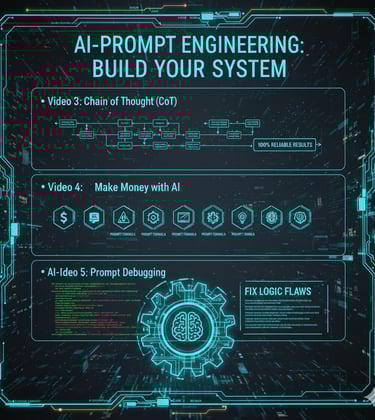
Video 3: Chain of Thought (CoT) – Master the reasoning process for 100% reliable results.


The true power of AI lies not just in what you ask, but how you ask it. In this session, we reveal the "secret weapon" of professional prompt engineering: Chain of Thought (CoT). By forcing the AI to explicitly state its reasoning and think step-by-step, we transform it from a generic chatbot into a detailed, analytical, and reliable collaborative partner for your most complex tasks.
Apply the CoT methodology to move beyond shallow results in any domain:
1. The Senior Market Strategist (Business Logic):
◦ Role: Evaluating the viability of a new AI-powered service.
◦ Prompt: "Act as a senior market strategist. Analyze the viability of [Project]. Follow the chain of thought approach: first, explicitly state your reasoning for each point. Let's think step by step."
◦ Result: A structured analysis covering competitive landscapes and pros/cons before reaching a recommendation.
Prompt: Act as a Senior Market Strategist. Analyze the viability of launching a new AI-powered personalized news aggregator service in the current digital media market. Your analysis must consider: 1. Competitive Landscape (top 3 rivals, like Google News, Apple News, and Flipboard). 2. Pricing Strategy (premium subscription vs. ad-supported free model). 3. Target Audience (demographics and pain points of Gen Z and Millennials). Please follow the Chain-of-Thought approach. First, explicitly state your reasoning for each of the three points above, and only then provide your final recommendation and strategy summary. Let's think step by step.
2. The Professional Content Architect (SEO & Structure):
◦ Role: Developing high-performance content outlines.
◦ Prompt: "You are a professional content architect. Before creating the final outline, first generate a high-level thinking process that explains how you determined the flow and structure based on search intent."
◦ Result: Superior SEO performance by forcing the AI to analyze search intent before writing.
Prompt: You are a professional Content Architect. Develop a detailed, 1500-word blog post outline on the topic: "The Future of Prompt Engineering: From Niche Skill to Essential Business Tool." Your outline must include: - A compelling hook idea (e.g., using a shocking statistic). - 5 main sections, each with at least 3 sub-points. - A strong conclusion that includes a clear Call to Action (e.g., "Start your learning journey"). Before creating the final outline, first generate a high-level thinking process that explains how you determined the flow and structure of the post. First, analyze the intent of the search query, and then proceed with the outline generation.
3. The High-Value Debugger (Technical Logic):
◦ Role: Analyzing and fixing vulnerabilities in code.
◦ Prompt: "Analyze the following code snippet using the chain of thought methodology. Break down the code line by line and show your step-by-step analysis before the final output."
◦ Result: Pinpoints security flaws and logic errors that a general prompt would miss.
Prompt: I am a Junior Developer working with Python. Analyze the following code snippet and identify any potential bugs, security vulnerabilities, or performance issues related to handling user financial data and API calls.
def get_stock_price(symbol, api_key):
url = f"https://api.finance.com/price?symbol={symbol}&key={api_key}"
response = requests.get(url)
data = response.json()
return data['price']
Please use the Chain-of-Thought methodology. Break down the code line by line, explaining the function of each critical segment. After the breakdown, state your findings in a table format (Issue Type | Location | Proposed Fix). Show your step-by-step analysis before the final output.
4. The CEO & Hacker (Creative Problem Solving):
◦ Role: Solving complex marketing or engagement challenges.
◦ Prompt: "Generate three unconventional solutions to [Problem]. Evaluate the pros and cons of each solution idea in a separate paragraph before presenting the final plan. Think like a CEO and a hacker simultaneously."
◦ Result: Eliminates generic ideas and produces actionable, creative strategies with complexity estimates.
Prompt: We are facing a Web3/NFT project challenge: Our community engagement on Discord has dropped by 30% after the minting phase, leading to 'floor price' stagnation. Generate three distinct and unconventional solutions to this problem. For each solution, you must: 1. Briefly explain the underlying principle. 2. Detail 3 actionable steps to implement the solution. 3. Estimate the complexity (Low, Medium, High). Use Chain-of-Thought: Dedicate a separate paragraph to evaluate the pros and cons of each solution idea before presenting the final detailed plan. Think like a CEO and a hacker simultaneously.
This video activates the "Magnifying Glass" (Analysis & Detail) and "Brain" (AI & Intelligence) pillars of our methodology. It is a fundamental shift from simple interaction to deep systematic engineering.
Video 4: Make Money with AI – Turn your skills into income with 5 proven prompt formulas.



💸 MAKE MONEY with ChatGPT in 2025: 5 Proven Prompt Formulas for Generating Business Ideas Video
💸 MAKE MONEY with ChatGPT in 2025: 5 Proven Prompt Formulas for Generating Business Ideas Shorts
Phase 2:
Logic & Architecture (The Collaborative Partner)
🤯 GET 90% BETTER RESULTS FROM CHATGPT! CHAIN OF THOUGHT Prompt Technique Video

🤯 GET 90% BETTER RESULTS FROM CHATGPT! CHAIN OF THOUGHT Prompt Technique Shorts
Mastery without monetization is just a hobby. In this session, we take the advanced techniques you've learned—like Chain of Thought—and turn them into scalable income streams. We are moving beyond vague business ideas and providing you with 5 proven, copy-and-paste prompt formulas that allow you to offer high-value professional services in the 2025-2026 economy.
Use these specific formulas to transform ChatGPT into your personal income generator and create profitable professional services:
1. The High-Converting Ad Copy Expert:
◦ Goal: Create sales copy that actually converts.
◦ Function: Uses psychological triggers and structured logic to draft ads for social media and landing pages.
PROMPT FORMULA #1: High-Converting Ad Copy You are a world-class Direct Response Copywriter. Your task is to generate five unique advertising headlines and body texts using the AIDA framework for a client selling [PRODUCT/SERVICE].
The target audience is [TARGET AUDIENCE] who struggles with [SPECIFIC PAIN POINT].
Your output must be in a table format with columns for: Headline, Body Text (AIDA breakdown), and Call-to-Action. Focus on a strong sense of urgency and benefit-driven language.
SEO optimized blog content writing service Small business owners (especially local services like dentists, lawyers, and contractors) Wasting time trying to write content that never ranks on Google
2. Niche Keyword Clustering & SEO Strategy:
◦ Goal: Offer high-level SEO consulting.
◦ Function: Groups keywords into strategic clusters to build topical authority for brands.
PROMPT FORMULA #2: Niche Keyword Clustering Act as an expert SEO Strategist. I need a content plan for a niche blog focused on [NICHE TOPIC, e.g., 'Sustainable Urban Gardening'].
Generate 10 low-competition, high-intent keyword clusters. For each cluster, suggest a compelling blog post title, and define the user's search intent (Informational, Navigational, or Transactional). Present the results in a structured list. LinkedIn Optimization for Remote Software Developers
3. The Marketable Digital Product Outline:
◦ Goal: Create and sell your own digital assets.
◦ Function: Generates structured, high-value outlines for E-books, courses, or guides ready for production.
PROMPT FORMULA #3: Marketable Digital Product Outline You are a Digital Product Development Consultant. I want to create a comprehensive video course titled [COURSE TITLE, e.g., 'Mastering Midjourney V6: From Beginner to Pro'].
Generate a detailed course outline consisting of 6 modules. Each module must contain 5-7 specific, high-value lessons. The structure should aim to solve the buyer's major problem and lead them to a clear, measurable outcome. Ensure the language used is highly appealing to potential customers. * Mastering Data Visualization in Tableau: A Practical Guide for Beginners
4. The Client Proposal & Scope Definition:
◦ Goal: Win high-ticket freelance or agency clients.
◦ Function: Drafts professional proposals that clearly define project boundaries, timelines, and value propositions.
PROMPT FORMULA #4: Client Proposal & Scope Definition Act as a Professional Business Analyst and Proposal Writer. A potential client needs help defining the scope for a new project: [CLIENT PROJECT, e.g., 'Developing a new employee onboarding process'].
Draft a project proposal outline that includes:
1. Project Objectives (3 bullet points).
2. Defined Scope of Work (5-7 clear tasks).
3. Out-of-Scope Items (3 clear exclusions).
4. Deliverables. 5. Estimated Timeline (in weeks).
Frame the document using clear, confident business language. Developing an Automated Supply Chain and Logistics Process for a Small E-commerce Brand
5. Technical Documentation & SOP Creation:
◦ Goal: Offer operational efficiency services to businesses.
◦ Function: Turns messy workflows into clean, professional Standard Operating Procedures (SOPs) and manuals.
PROMPT FORMULA #5: Technical Documentation (SOP Creation) You are a Process Automation Specialist. I need a detailed Standard Operating Procedure (SOP) for the task: [TASK, e.g., 'Setting up and tracking a Google Analytics 4 conversion event'].
The SOP must be written for a non-technical virtual assistant and include:
1. A brief overview of the goal.
2. A numbered, step-by-step instruction list (including specific actions and screenshots notes).
3. A checklist for quality assurance. The tone must be clear, precise, and easily replicable.
This video activates the "Up Arrow" (Growth & Scaling) and "Gear" (Methodology & Process) pillars of our methodology. It represents the bridge between being an AI user and becoming an AI-driven entrepreneur.
Video 5: Prompt Debugging
– Ensure precision in critical tasks by identifying and fixing logic flaws.
🛠️ The Prompt Debugging Guide: 5 Rules to Fix Generic AI Outputs Every Time 🛠️ Shorts
🛠️ The Prompt Debugging Guide: 5 Rules to Fix Generic AI Outputs Every Time 🛠️ Video



Accuracy is not an option; it is a requirement for high-stakes professional work. In this session, we move beyond creative generation and enter the realm of Logic Auditing. You will learn how to "debug" your prompts and the AI's outputs to ensure 100% reliability. By forcing the AI into a self-correcting loop, we eliminate hallucinations and structural errors, making it a safe partner for critical business and technical tasks.
Master these advanced auditing techniques to handle critical assignments with surgical precision:
1. The System Auditor Role (Failure Analysis):
◦ Prompt: "Act as an expert system auditor. Analyze the following process/output for potential logic flaws, risks, and missing steps. Provide the results in a clear table format".
◦ Result: Instantly identifies weaknesses that a standard review would miss, providing actionable solutions.
2. Line-by-Line Logic Breakdown (Technical Debugging):
◦ Process: Use this for complex code or strategic documents.
◦ Prompt: "Analyze this code/text line-by-line. Explain the function of each segment and identify any security vulnerabilities or logic errors before providing a final corrected version".
◦ Result: High-value assistance that pinpoints specific vulnerabilities, such as API key handling or strategic inconsistencies.
3. The Stress-Test Methodology:
◦ Concept: Forcing the AI to critique its own reasoning before final delivery.
◦ Action: Incorporate "Failure Analysis" into your Chain of Thought process to ensure the final output survives professional scrutiny.
PROMPT: "Act as a Certified Regulatory Compliance Officer specializing in EU and US data law. The report must specifically analyze GDPR and CCPA compliance risks for a SaaS startup with 50 employees. First, list the top 5 areas of risk. Then, for each risk, provide a recommended mitigation action. Process these two steps sequentially. Your final answer must be presented in a markdown table format with three columns: Risk Area, Relevant Regulation, and Mitigation Action. Do not include generic legal disclaimers, and strictly avoid using the words 'synergy' or 'optimization' in the final summary."
This video is the embodiment of the "Magnifying Glass" (Analysis & Detail) pillar of our methodology. It represents the bridge between "getting an answer" and "engineering a result" that you can stake your professional reputation on.
Stop spying on your competitors and start outmaneuvering them. Knowing your market isn't about guessing; it's about data-driven positioning. In this session, we enter Phase 3: Strategic Ascension, where we transform AI into a high-level boardroom consultant. Using our 3-step framework, you will learn to identify exactly what your rivals are ignoring and turn their weaknesses into your primary competitive advantage.
Turn weeks of traditional market research into minutes of strategic clarity using these professional AI frameworks:
1. Step 1: Product Gap Analysis (The Senior Product Strategist):
◦ Goal: Find your "Blue Ocean"—the space where you have no competition.
◦ Action: Feed the AI competitor features and customer reviews to find unmet needs and missing features.
◦ Result: A clear map of what the market is starving for, allowing you to build what actually sells.
🟢 ChatGPT Prompt 1: Act as a Senior Product Strategist specializing in SaaS B2B markets. Your task is to perform a "Product Gap Analysis."
Here is information about two competitors and general customer complaints:
Competitor A (e.g., "ProjectFlow"):
- Features: Advanced project management, time tracking, basic CRM integration, team collaboration, reporting.
- Strengths: Robust task management, good for large teams.
- Weaknesses: Steep learning curve, expensive for small teams, limited mobile functionality.
Competitor B (e.g., "TaskMaster"):
- Features: Intuitive task tracking, simple dashboards, integrated chat, budget tracking, quick setup.
- Strengths: User-friendly, affordable, excellent mobile app.
- Weaknesses: Lacks advanced reporting, poor scalability for growth, no deep CRM integration.
General Customer Complaints (from industry reviews):
- "Existing solutions are too complex for small businesses."
- "Pricing models are opaque and often too high for startups."
- "Lack of clear ROI tracking in many project tools."
- "Poor cross-platform integration between mobile and desktop apps."
- "Generic reporting features that don't allow custom metrics."
Based on this data, identify 3 significant "Product Gaps" where a new SaaS product could enter the market and solve a problem that these competitors are either ignoring or underperforming on.
Present your findings in a structured "Blue Ocean Strategy" table with three columns:
1. Product Gap Identified: (Briefly describe the unmet need/ignored problem)
2. Target Niche/Value Proposition: (Who would benefit and what unique value would you offer?)
3. Key Feature Suggestion: (One concrete feature to address the gap)
Ensure the language is analytical, strategic, and concise.
2. Step 2: Customer Sentiment Analysis (The Pain Point Hunter):
◦ Goal: Solve what the current market leaders are failing at.
◦ Action: Instantly analyze thousands of negative reviews to identify recurring frustrations.
◦ Result: Your marketing will now focus on the exact solutions your audience is desperate for—such as "zero-effort setup" if competitors are too complex.
🟢 ChatGPT Prompt 2:
Act as a highly skilled Market Research Analyst. Your goal is to perform "Customer Sentiment Analysis" on competitor products to identify key pain points and potential marketing opportunities for a new market entrant.
Here is a compilation of customer reviews for competitor products in the [Your Industry - e.g., SaaS Project Management]:
Customer Reviews Data:
- "Their software is powerful but it took me weeks to figure out how to use it. The setup process is a nightmare." (Competitor A)
- "I love the features, but it's ridiculously expensive for a small team. The pricing structure is predatory." (Competitor A)
- "The mobile app crashes constantly and doesn't sync with the desktop. Frustrating." (Competitor A)
- "Very easy to use, but I wish it had better reporting tools. I can't customize anything." (Competitor B)
- "Great for basic tasks, but it doesn't scale well. My team grew, and the tool couldn't keep up." (Competitor B)
- "Customer support is slow and unhelpful when I have integration issues." (General)
- "There's no clear way to track the actual return on investment from using these tools." (General)
- "Too many features I don't need, making the interface cluttered and confusing." (Competitor A)
Analyze these reviews to extract 3-5 recurring "Pain Points" that customers consistently experience. For each pain point, translate it into a "Marketing Opportunity" for a new product, focusing on how a new solution could address that pain point.
Present your findings in a table with two columns:
1. Customer Pain Point: (Specific, recurring complaint)
2. Marketing Opportunity/Value Proposition: (How a new product can turn this pain point into a strength)
Ensure the analysis is sharp, actionable, and identifies clear selling points.
3. Step 3: Marketing Reverse Engineering (The Playbook Deconstructor):
◦ Goal: Deconstruct their psychological triggers to write a better playbook.
◦ Action: Analyze ad hooks and landing page copy to identify if they sell based on fear, status, or efficiency.
◦ Result: You move from being an observer to an architect, positioning yourself for total market dominance.
🟢 ChatGPT Prompt 3: Pazarlama Tetikleyicileri ve Karşı Strateji
Act as a Master Marketing Strategist specializing in psychological triggers and persuasive copywriting. Your task is to perform "Marketing Reverse Engineering" on competitor ad copy and landing page headlines.
Here are examples of competitor marketing messages:
Competitor A Marketing Messages:
- Ad Slogan: "Unleash Your Team's Full Potential: The Most Comprehensive Project Management Solution."
- Landing Page Headline: "Stop Losing Sleep Over Complex Projects. Gain Control. Achieve Excellence."
- Key Feature Highlight: "Advanced Analytics & Custom Reporting."
Competitor B Marketing Messages:
- Ad Slogan: "Simplify Your Workflow: Project Management Made Easy for Everyone."
- Landing Page Headline: "Get Started in 5 Minutes. Boost Your Productivity Instantly."
- Key Feature Highlight: "Intuitive Interface & Mobile-First Design."
Analyze these messages to identify:
1. The primary Psychological Trigger each competitor is attempting to activate (e.g., Fear, Aspiration, Efficiency, Status, Relief, Belonging).
2. The core Value Proposition they are selling.
3. A Counter-Marketing Strategy/Message that a new competitor could use to position themselves effectively against these.
Present your analysis in a structured table with three columns:
1. Competitor & Message: (Specify Competitor A/B and the message)
2. Identified Psychological Trigger & Value: (e.g., "Fear of Failure, selling Control")
3. Counter-Strategy for New Entrant: (A concise message to differentiate and appeal to the same/different audience)
Your analysis should be sharp, insightful, and provide actionable strategic direction.
This video activates the "Compass" (Strategy & Direction) pillar of our methodology. It guides you away from noise and toward the strategic void where your professional authority can truly grow.
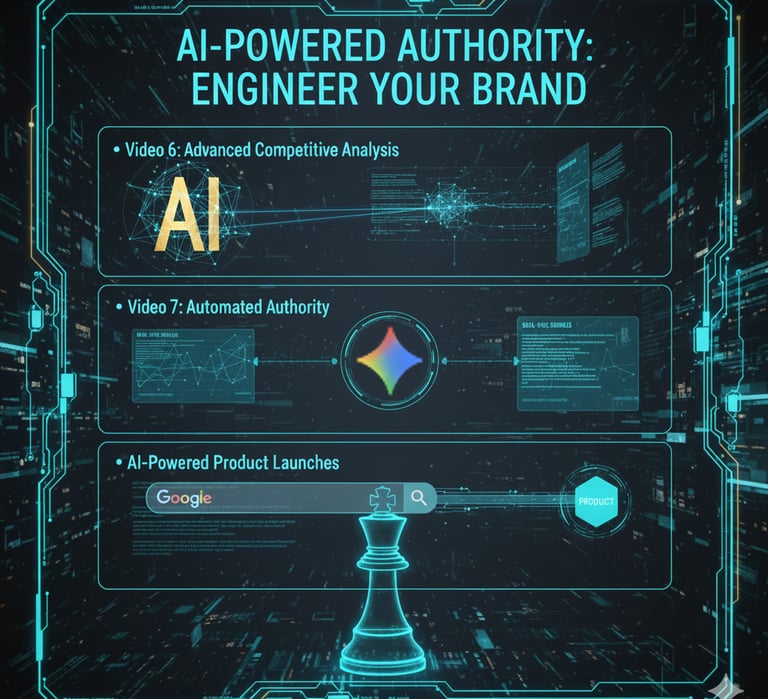
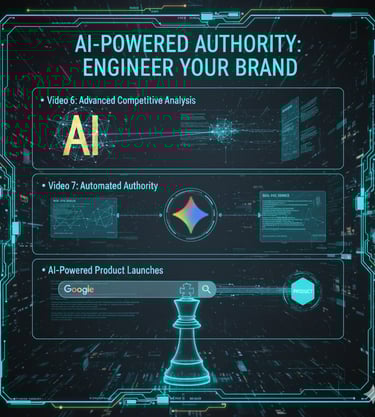
Video 6: Advanced Competitive Analysis
– Identify market gaps and reverse-engineer competitor triggers.




‼️Stop Spying, Start Outmaneuvering Shorts
🔍 Master Your Market: Advanced Competitive Analysis with AI (Step-by-Step) Video

Phase 3:
Strategic Ascension (The Authority)
Establish market dominance. Use data-driven engineering to build your personal brand and outmaneuver the competition.

Video 7: Automated Authority
– Use real-time signals to engineer a content ecosystem that builds trust.


🚀Automated Authority: How Real-Time Data Builds Personal Brands in 2026 Shorts
🚀 Automated Authority: Building a 2026 Personal Brand with Google Gemini Video
Personal branding is broken. Most people focus on visibility, but Authority is not Visibility—it is filling a gap the market is actively searching for. In this session, we use the real-time power of Google Gemini to move from manual content creation to Data-Driven Engineering. You will learn how to identify your "Authority Gap" and build a strategic fortress that positions you as a visionary leader rather than just another voice in the noise.
Stop guessing what the market wants and start controlling how the market positions you with this engineered framework:
1. Pillar 1: Authority Gap Analysis (The Senior Consultant):
◦ Goal: Find the "Strategic Void"—high-demand areas that lack clear expertise.
◦ Action: Use specific prompts to scan live search data and identify value topics ignored by industry leaders.
◦ Result: You define a unique market position where you are not competing, but providing the missing piece.
Prompt: "Act as a Senior Personal Branding Consultant and Market Analyst. Access Google Search to analyze the current state of thought leadership in [Your Industry name].
Identify the top 5 influencers in this niche and their core messaging patterns.
Based on current industry reports and news from the last 6 months, find the 'Authority Gap'—a specific area that is high in demand but low in high-quality expert content.
Suggest a 'Unique Value Proposition' (UVP) that positions me as the primary expert to fill this gap for 2026. Present your findings in a systematic strategic report format."
2. Pillar 2: Engineering the Content Ecosystem (The 30-Day Engine):
◦ Goal: Transform strategy into disciplined execution.
◦ Action: Use Gemini to engineer a structured 30-day publishing plan that moves your audience from awareness to systematic trust.
◦ Result: Consistency is no longer manual; it is a growth engine managed by logic.
Prompt: "Using the 'Authority Gap' and UVP identified in the previous step, engineer a 4-week 'Authority Content Framework.' Your goal is to move the audience from 'Awareness' to 'Trust'.
Week 1: Deconstructing industry myths (Strategic Thinking).
Week 2: Data-backed case studies or logic frameworks (Expertise).
Week 3: Future-casting 2026 predictions (Visionary Leadership).
Week 4: Direct engagement and high-signal calls to action (Conversion). Provide 3 specific 'Hook' ideas for each week that are designed to trigger high-professional engagement on LinkedIn and Twitter/X. Format this as a structured table."
3. Pillar 3: Real-Time Signal Capture (Visionary Leadership):
◦ Goal: Capture the present moment to cement your authority.
◦ Action: Scan the last 24 hours of industry news and synthesize it with your core expertise to produce "High-Signal" thought leadership.
◦ Result: You move from being an observer to a visionary who predicts and deconstructs trends.
Prompt: "Access real-time Google Search data for the last 24 hours regarding [Your Industry name].
Identify the most significant breaking news or emerging trend.
Synthesize this news with my brand’s core expertise.
Draft a 'High-Signal Thought Leadership' post that provides a counter-intuitive perspective on this trend. The tone must be authoritative, minimalist, and data-driven. Avoid generic AI language; focus on deep strategic insight."
This video activates the "Up Arrow" (Growth & Scaling) pillar of our methodology. In 2026, authority isn't created—it's engineered with scientific precision.
AI-POWERED PRODUCT LAUNCHES Video

AI-POWERED PRODUCT LAUNCHES Shorts
Video 8: AI-Powered Product Launches
– Transform authority into revenue through professional launch engineering.
This is the finale of your transformation. In this session, we move beyond building authority and enter the realm of Launch Engineering. We don't just "release" products; we engineer market dominance by turning the strategic signals we’ve captured into high-performance revenue engines. This is where your personal brand meets professional scalability, ensuring that your entry into the market is not just noticed, but felt.
Mastering the final transition from a recognized authority to a market leader using three strategic steps:
1. Step 1: The Precision Launch Map (The Target Pillar):
◦ Goal: Eliminating noise to focus on the high-impact "Core" results.
◦ Action: Using AI to architect a launch sequence that aligns your unique value proposition with the market gaps identified in Phase 3.
◦ Result: A laser-focused entry strategy that hits the exact pain points of your sophisticated audience.
2. Step 2: Scaling the Authority (The Up Arrow Pillar):
◦ Goal: Transforming initial traction into measurable, scalable success.
◦ Action: Engineering automated workflows that handle the surge in demand while maintaining the "High-Signal" quality of your brand.
◦ Result: Sustainable growth that doesn't rely on manual repetition but on strategic systems.
3. Step 3: Dominating the 2026 Landscape:
◦ Goal: Moving from a participant to a visionary leader who writes the rules of the game.
◦ Action: Utilizing Agentic Workflows to continuously monitor market shifts and adapt your product ecosystem in real-time.
◦ Result: Long-term professional dominance through constant adaptability and human judgment.
"Act as a World-Class Launch Strategist. Access Google Search to find the top 3 pain points in [Your Industry] for 2026. Based on these, architect a 14-day product launch funnel for a new [Your Product/Service]. Include a daily content goal, a specific psychological trigger for each day, and a draft for a high-converting announcement email. The tone must be premium, authoritative, and direct."
"Act as a World-Class Launch Strategist. Access Google Search to analyze the current [YOUR INDUSTRY] trends for January 2026.
Identify the 'Highest Intent' problem customers are currently facing.
Create a 14-day content calendar for a product launch that addresses this specific problem.
For Day 1, Day 7, and Day 14, provide a specific 'Hook' and a 'Call to Action' designed for high-ticket conversion. Present the entire strategy in a professional 'Launch Blueprint' table."
This video is the final activation of the "Target" (Focus & Goal Setting) and "Up Arrow" (Growth & Scaling) pillars. It marks the moment where theoretical potential officially transforms into a scalable strategic advantage.
Join the Core
Unlock your AI mastery journey today

Connect
Questions? Reach out anytime.
Grow
howto@thecoremethodhowto.com
© 2026. All rights reserved.